Reviewed by Sahil Chopra, MD, and Stacey Gunn, MD.
Snoring in children is often overlooked, thought of as being “cute” rather than a potential problem worthy of addressing. But studies over the past two decades have repeatedly demonstrated increased rates of behavioral and cognitive issues in children who snore.
Snoring in children is a condition that should be treated if the child is snoring habitually. Occasional snoring in the context of a cold isn’t worrisome, but consistent snoring three or more nights a week warrants evaluation for sleep apnea. Sleep apnea occurs where there is blockage in the airway causing decreased airflow. Children who experience interrupted sleep may also undergo structural changes in the frontal lobe of their brain. The frontal lobe regulates decision-making, memory retrieval, reasoning, executive functioning (planning, focus, impulse control, adaptability, and multi-tasking), and problem-solving.
What Causes Children To Snore?
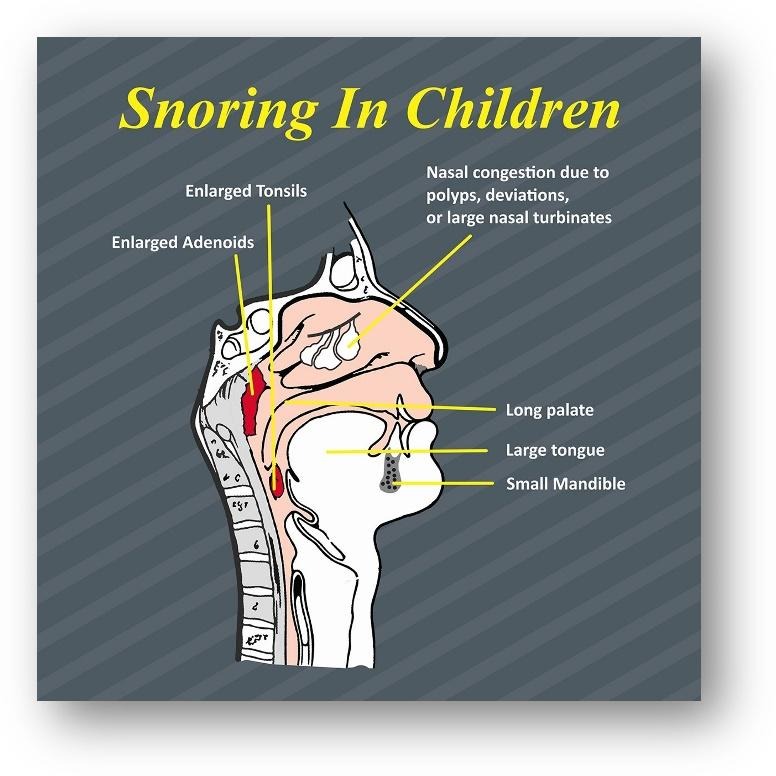
- Physical obstruction (see Figure 1)
- Enlarged adenoids and tonsils
- Nasal congestion due to allergy
- Deviated septum in nose
- Long palate
- Large tongue
- Small jaw
- Obesity
- Poor air quality
- A cold or other respiratory infection
- Asthma
- Other medical conditions
- Cerebral palsy
- Down Syndrome
What Evidence Is There That Snoring Causes Behavioral Changes In Children?
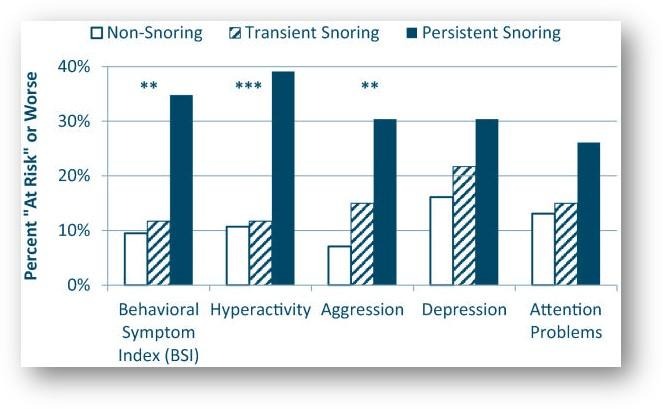
Many studies have linked behavioral issues with the number of awakenings children experience at night. Figure 2 shows the results of a study in which preschoolers (ages 2-3yrs) who snored at least three nights a week showed an increase in behavioral issues.
Is Cognitive Development Affected By Snoring?
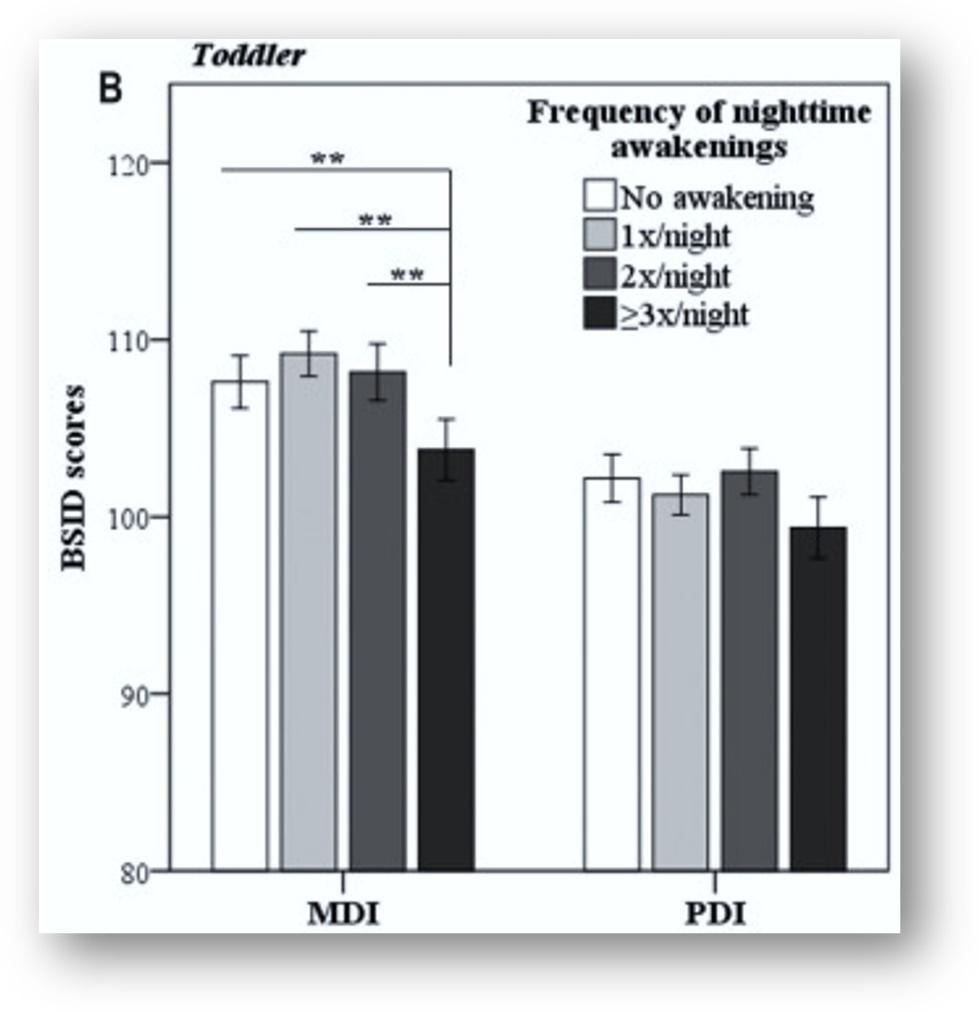
In addition to behavior, studies also correlated lower cognitive development with habitual sleep awakenings. Figure 3 shows toddlers (aged 12-30 months) had significantly lower scores on the mental development index (MDI) if they had three or more awakenings at night.
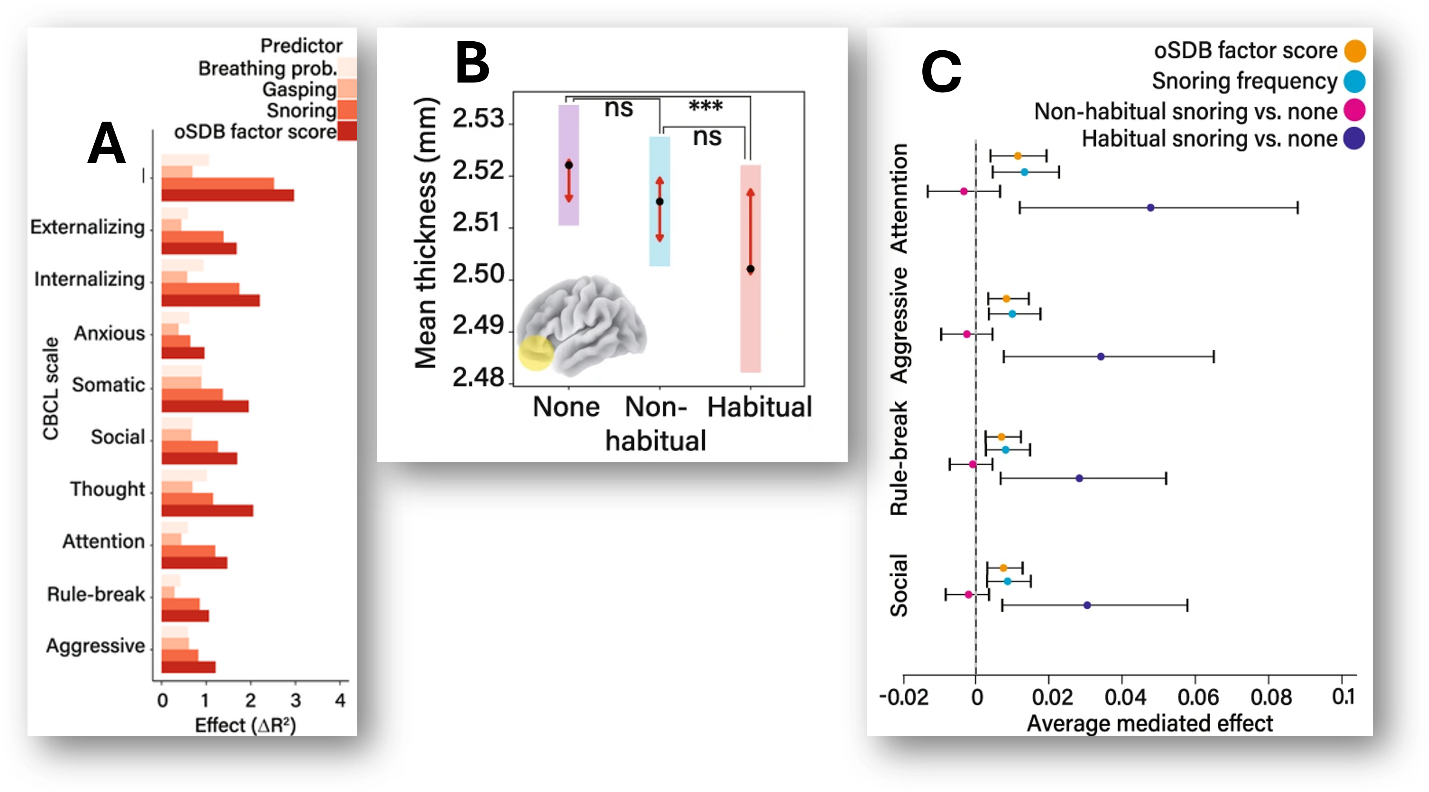
Additional studies also show a correlation between snoring and behavioral and developmental issues. Why do these correlations exist? One of the largest studies done to date on snoring and behavior set out to answer this question. It included over 10,000 children and successfully linked behavioral and cognitive issues from snoring to a physical change in brain structure. A sampling of the results can be seen in Figure 4. The behaviors used in the study use the child behaviors checklist (CBCL) which is described in more detail below.
Behaviors Studied That Are Linked To Snoring:
- Internalized Behaviors
- Anxiety – worrying and/or fear which impedes day to day activities
- Depression/withdrawn – feelings of deep sadness and hopelessness
- Physical (somatic) complaints including:
- Weakness
- Dizziness
- Headaches
- Fatigue
- Memory issues
- Stomach issues
- Bowel problems
- Twitching
- Externalized Behaviors
- Emotionally reactive problems
- Aggressiveness
- Social issues
- Rule-breaking behavior
- Attention issues – being unable to focus on a task
- Thought problems
- Obsessive/compulsive tendencies
- Hallucinations
- Self-harm
- Emotionally reactive problems
These behavioral issues and a snoring frequency of at least three nights a week (Figure 4A) were associated with the physical thinning of the outer part of the frontal lobe by MRI measurements (Figure 4B). Habitual snoring had significant negative associations with attention, aggressiveness, rule-breaking behavior, and social issues (Figure 4C). It is thought that this change in development in the frontal cortex may be the mediator by which snoring and sleep apnea contributes to behavioral issues.
Solutions To Childhood Snoring:
If your child snores just occasionally when they are sick or congested, a humidifier, air purifier, allergy medication, or simply encouraging side sleeping can help. If your child snores on a regular basis, then please consider having them evaluated by a sleep health professional. A doctor can decide whether snoring should be treated with allergy treatments, attention to nasal breathing and tongue position, surgery (removal of adenoids or tonsils), weight management, or the use of a CPAP machine while sleeping. Don’t delay getting your child a physical examination, as it can have long-term effects on their cognitive development! (Beebe, Rausch, Byers, Lanphear, & Yolton, 2012)
References
Beebe, D. W., Rausch, J., Byers, K. C., Lanphear, B., & Yolton, K. (2012, September). Persistent Snoring in Preschool Children: Predictors and Behavioral and Developmental Correlates. Pediatrics, 130(3), 382-389.
Catani, M. (2019). The Frontal Lobes. In M. D'Esposito, & J. Grafman, Handbook of Clinical Neurology, Vol. 163 (3rd series) (p. Chapter 6). Elsevier.
Isaiah, A., Ernst, T., Cloak, C. C., Clark, D. B., & Chang, L. (2021). Associations between frontal lobe structure, parent-reported disrupted sleep disordered breathing and childhood behavior in the ABCD dataset. Nature Communications, 12(2205).
Parakh, D. (2020, August 25). Snoring in children: When to worry? Retrieved 2024, from Dr. Ankit Parakh: https://www.ankitparakh.com/snoring-in-children-when-to-worry/
Study links structural brain changes to behavioral problems in children who snore. (2021, April 21). Retrieved from National Institutes of Health: https://www.nih.gov/news-events/news-releases/study-links-structural-brain-changes-behavioral-problems-children-who-snore
Sun, W., Li, S. Z., Jiang, Y., Xu, X., Spruyt, K., Zhu, Q., . . . Jiang, F. (2018). A Community-Based Study of Sleep and Cognitive Development in Infants and Toddlers. Journal of Clinical Sleep Medicine, 14(6), 977-984.
Suni, E., & Gould, J. (2023, November 22). Snoring in Children. Retrieved from Sleep Foundation: https://www.sleepfoundation.org/snoring/snoring-children


.png)
.png)